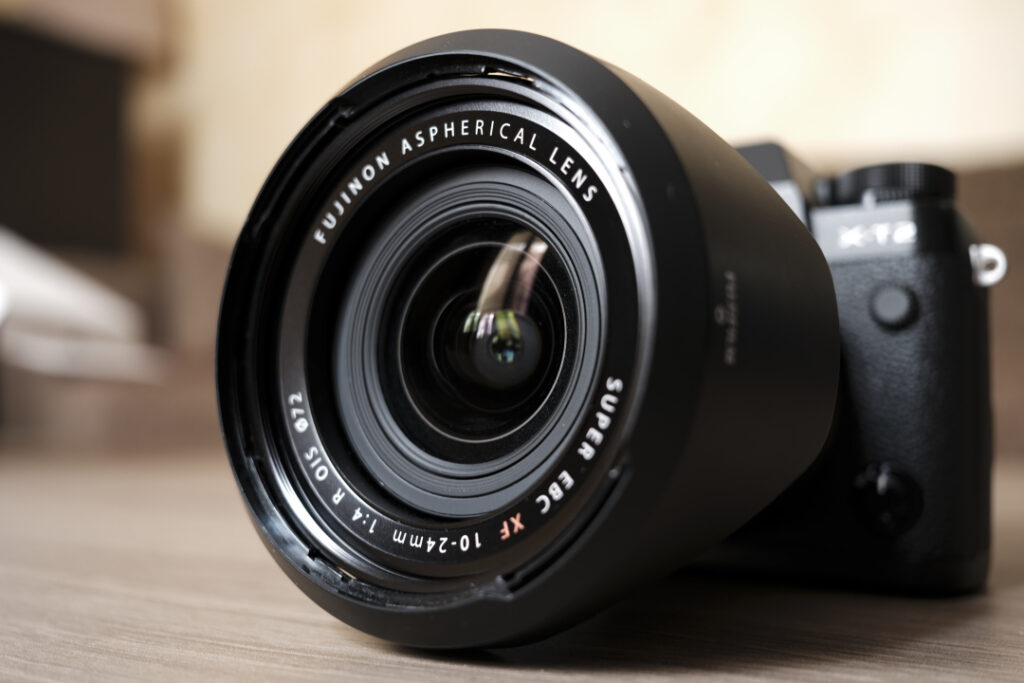
Modern lenses are not just shaped pieces of glass—they are the result of complex optical calculations designed to precisely control how light propagates through materials.
1. Refraction and Snell’s Law
At the core of lens design is refraction, described by Snell’s Law :
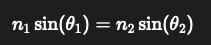
This equation governs how light bends when passing between materials with different refractive indices. Lens designers select glass types based on their refractive index (n) and dispersion (Abbe number).
2. Lens Maker’s Formula
The shape of a lens is calculated using the Lens Maker’s Formula:
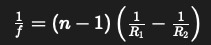
Where:
- ( f ) = focal length
- ( n ) = refractive index
- ( R_1, R_2 ) = radii of curvature
This formula determines how strongly the lens converges or diverges light.
3. Aberration Control
Real lenses suffer from imperfections such as:
- Spherical aberration
- Chromatic aberration
- Coma and astigmatism
To correct these, engineers combine multiple lens elements made from different types of glass. For example:
- Crown glass (low dispersion)
- Flint glass (high dispersion)
Achromatic doublets are designed to minimize color fringing by aligning focal points of different wavelengths.
4. Optical Design Optimization
Modern lenses are designed using ray tracing software. Engineers simulate thousands of light rays passing through multiple elements to optimize:
- Modulation Transfer Function (MTF)
- Distortion
- Field curvature
The goal is to maximize sharpness and contrast across the entire image.
5. Aspherical Surfaces
Instead of simple spherical curves, many lenses use aspherical surfaces defined by equations like:
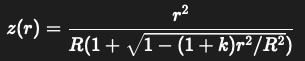
These reduce aberrations and allow for fewer lens elements.
6. Manufacturing Tolerances
Once designed, lenses must be manufactured with extremely tight tolerances:
- Surface accuracy: often within nanometers
- Alignment precision: micrometer scale
Even tiny deviations can degrade performance, so interferometry is used to verify surface quality.
現代のレンズは単なるガラスではなく、光の挙動を正確に制御するための数式に基づいて設計されています。
1. 屈折とスネルの法則
光の屈折は次の式で表されます:
異なる屈折率を持つ媒体間で光がどのように曲がるかを示します。
2. レンズメーカーの公式
レンズの焦点距離は次の式で決まります:
- ( f ):焦点距離
- ( n ):屈折率
- ( R_1, R_2 ):曲率半径
3. 収差補正
実際のレンズには以下の収差が存在します:
- 球面収差
- 色収差
- コマ収差・非点収差
これらを補正するために、異なる特性を持つ複数のレンズを組み合わせます。
4. 光学設計の最適化
現代ではレイトレーシングを用いて光線の挙動をシミュレーションし、
MTFや歪曲収差などを最適化します。
5. 非球面レンズ
非球面形状は次のような式で表されます:
これにより収差を大幅に低減できます。
6. 製造精度
ナノメートルレベルの精度が求められ、干渉計測などで品質が確認されます。
Les lentilles modernes sont conçues à partir de modèles mathématiques précis qui décrivent le comportement de la lumière.
1. Réfraction et loi de Snell
La réfraction est décrite par :
Cette loi définit la déviation de la lumière entre deux milieux.
2. Formule du fabricant de lentilles
La distance focale est donnée par :
3. Correction des aberrations
Les défauts optiques incluent :
- aberration sphérique
- aberration chromatique
- coma et astigmatisme
Ils sont corrigés en combinant plusieurs éléments optiques.
4. Optimisation numérique
Les logiciels de conception utilisent le lancer de rayons pour optimiser la qualité d’image (MTF, distorsion).
5. Surfaces asphériques
Les surfaces asphériques suivent des équations complexes permettant de réduire les aberrations
6. Tolérances de fabrication
Les lentilles sont fabriquées avec une précision extrême (nanométrique), vérifiée par interférométrie.
Leave a Reply